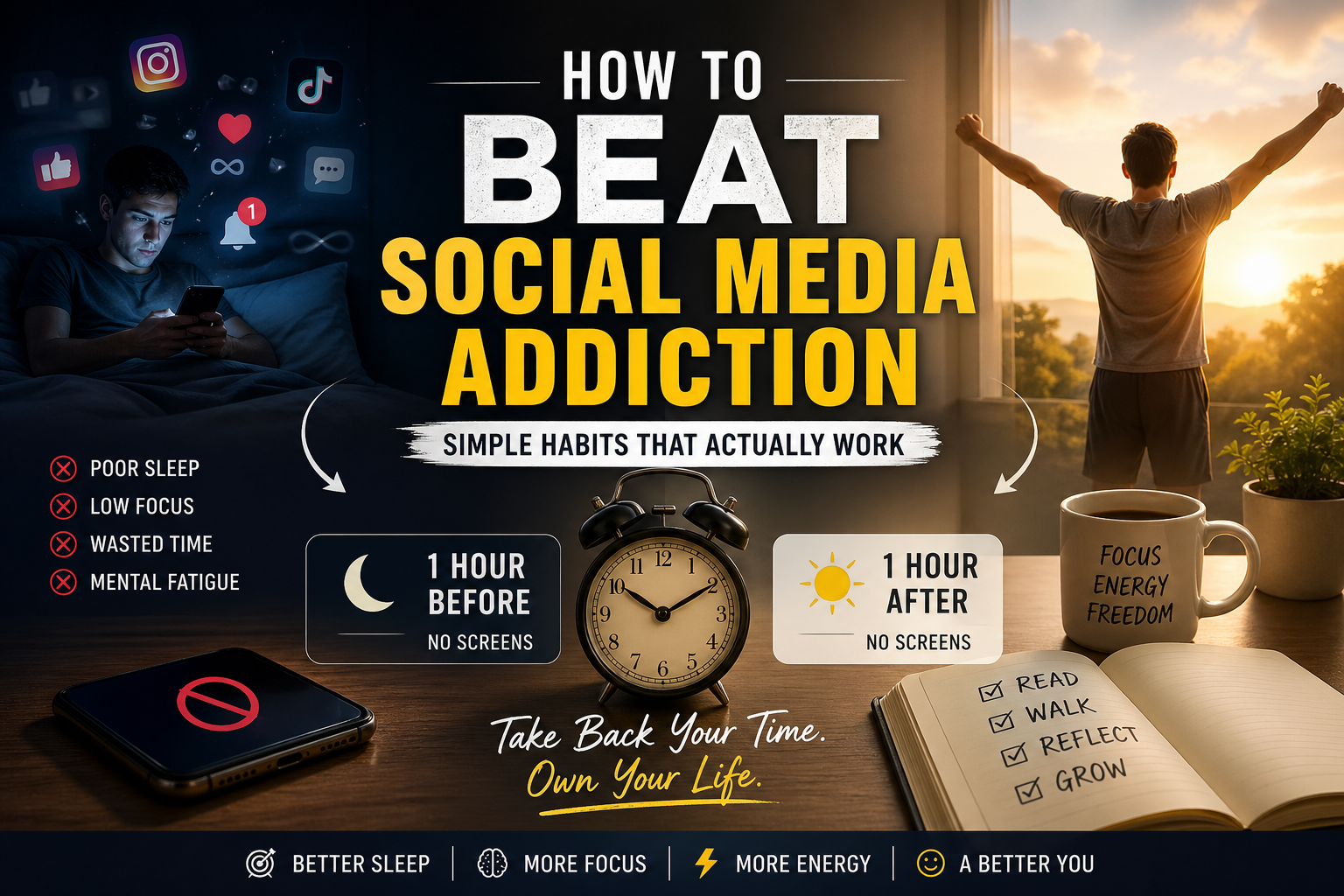
We’re living in a world where social media addiction is by design — and the biggest tech companies are spending billions of dollars to keep it that way. Designed to keep you hooked, these platforms are winning the battle against most people. In this article, I’ll show you some simple and powerful habits to fight back, reclaim your time, and start winning that battle yourself.
Table of Contents
It’s Not About You
If you’ve ever told yourself “I’ll just watch one more video” and suddenly it’s 2am — that’s not a lack of willpower. That’s by design.
The world’s biggest tech companies employ thousands of engineers, psychologists, and behavioural scientists with one single goal: to keep you on their platform as long as possible. Every scroll, every autoplay, every notification is carefully engineered to trigger a dopamine response in your brain — the same chemical behind gambling, gaming and sugar cravings. So before we talk about solutions, let’s be clear: this is not a personal failure. The system is built to defeat you.
The Real Cost You’re Not Seeing
The symptoms are easy to recognise. You open Instagram just to check something and thirty minutes disappear. You watch YouTube Shorts before bed and wonder why your evenings feel so short. You sleep 7–8 hours and still wake up exhausted, dragging yourself through the morning.
Sound familiar?
The problem goes deeper than lost time. Screens — especially smartphones and laptops — emit blue light, a short-wavelength light that directly interferes with your body’s production of melatonin, the hormone responsible for making you feel sleepy. When you scroll in bed, your brain receives a signal that it’s still daytime, delaying your sleep cycle and reducing the quality of deep, restorative sleep — even if you technically spend 8 hours in bed.
The light coming from your phone screen isn’t just distracting — it’s biologically disruptive. Screens emit blue light, a short-wavelength light that your brain interprets as daylight. This suppresses melatonin, the hormone your body uses to prepare for sleep. According to a 2022 scientific review published in Heliyon and indexed by the National Institutes of Health, evening exposure to blue light from digital devices is sufficient to delay sleep onset and reduce sleep quality — even at relatively low screen brightness levels. (Wong & Bahmani, 2022 — PMC9420367)
How to Deal With Social Media Addiction
The good news? As serious as this problem is, the solution doesn’t require a digital detox retreat or throwing your phone into the ocean. A few simple, consistent habits can make a remarkable difference — starting tonight.
Introducing: The 1 Hour Before, 1 Hour After Rule
The concept is straightforward. Switch off your screens 1 hour before you go to sleep, and don’t turn them back on until 1 hour after you wake up. That’s it. Two protected hours — one at each end of your day — where your mind belongs entirely to you. If you can stretch the evening side to two hours before bed, even better, but one hour is a powerful and realistic place to start.
Step 1: The 1 Hour Before — Shut Down Your Screens
Pick a time in the evening — 10 or 11pm works well for most people — and make it your daily switch-off time. At that hour, turn off your smartphone, laptop, and TV. No exceptions. As the NIH-backed study we mentioned earlier confirms, even low-level screen brightness in the evening is enough to suppress melatonin and delay your sleep. The earlier you cut the screens, the better your body can prepare for real, restorative rest.
Step 2: Fill That Hour With Something Worth Your Time
When you put the phone down, don’t just stare at the ceiling. This is the perfect moment to finally crack open that book you’ve been promising yourself you’d read “one day.” One day is tonight. A few chapters before bed will relax your mind, make you naturally sleepy, and give you something to look forward to each evening. Alternatively, go for a short walk around your neighbourhood. The fresh air, light movement, and change of scenery will help your body wind down naturally — making your sleep deeper and more restorative.
Step 3: The $5 Investment That Will Save Your Sleep
Right now you’re probably thinking: “But I use my phone as my alarm.” This is exactly the trap these companies want you in — because it means your phone is the last thing you see at night and the first thing you reach for in the morning. The fix is simple, cheap, and life-changing: go to your local store and buy a basic alarm clock. It costs anywhere between $5 and $10, and it will pay for itself in better sleep and energy within a week. Alternatively, if you’re upgrading to a new smartphone, don’t throw the old one away — wipe it, turn off all notifications, and use it purely as a bedside alarm with no apps or temptations within reach.
Step 4: The 1 Hour After — Own Your Morning
When you wake up, do not reach for your phone — not for at least the first hour. This single habit might be the most powerful one on this list. Your morning sets the tone for your entire day, and when the first thing your brain receives is a flood of notifications, news, and social media, you’ve already handed control of your attention to someone else before you’ve even had breakfast. Instead, use that first hour for yourself — stretch, make coffee, go for a walk, journal, or simply enjoy the quiet. You’ll feel the difference immediately, and over time, it will change the way you start every single day.
Conclusion: Don’t Let Them Win
The “1 Hour Before, 1 Hour After” rule won’t make headlines. No tech company will ever promote it. In fact, they’re counting on you never discovering it.
Reed Hastings, the co-founder and former CEO of Netflix, once openly admitted that Netflix’s biggest competitor isn’t YouTube, Amazon, or any other streaming platform — it’s sleep. When the CEO of one of the world’s most powerful entertainment companies looks at your eight hours of rest and sees a business problem to solve, that tells you everything you need to know about whose side these platforms are on.
They are not yours.
But here’s the thing — you don’t need to quit social media, smash your smartphone, or move off the grid to win this battle. You just need two hours a day that belong entirely to you. One before sleep. One after waking up. A $5 alarm clock. A book you’ve been meaning to read. A quiet morning walk.
Small habits. Enormous results. If that sounds familiar, it’s because it’s the core idea behind James Clear’s bestselling book Atomic Habits — where he argues that tiny, consistent changes are the engine behind every remarkable result in life. You don’t need a dramatic life overhaul. You just need the right small habits, repeated every day. The 1 Hour Before, 1 Hour After rule is exactly that — a tiny shift with the power to transform your sleep, your mornings, and your focus.
Your attention is the most valuable thing you own. Trillion-dollar companies are built on capturing it. The fact that you’ve read this far means you’re already ahead of most people — you’ve seen the game for what it is.
Now it’s time to play it on your own terms.
Switch off tonight. Wake up tomorrow as the winner.
Pingback: Why Do People Fail in Life? Napoleon Hill's 30 Causes of Failure (Think and Grow Rich) - Enes Aliev