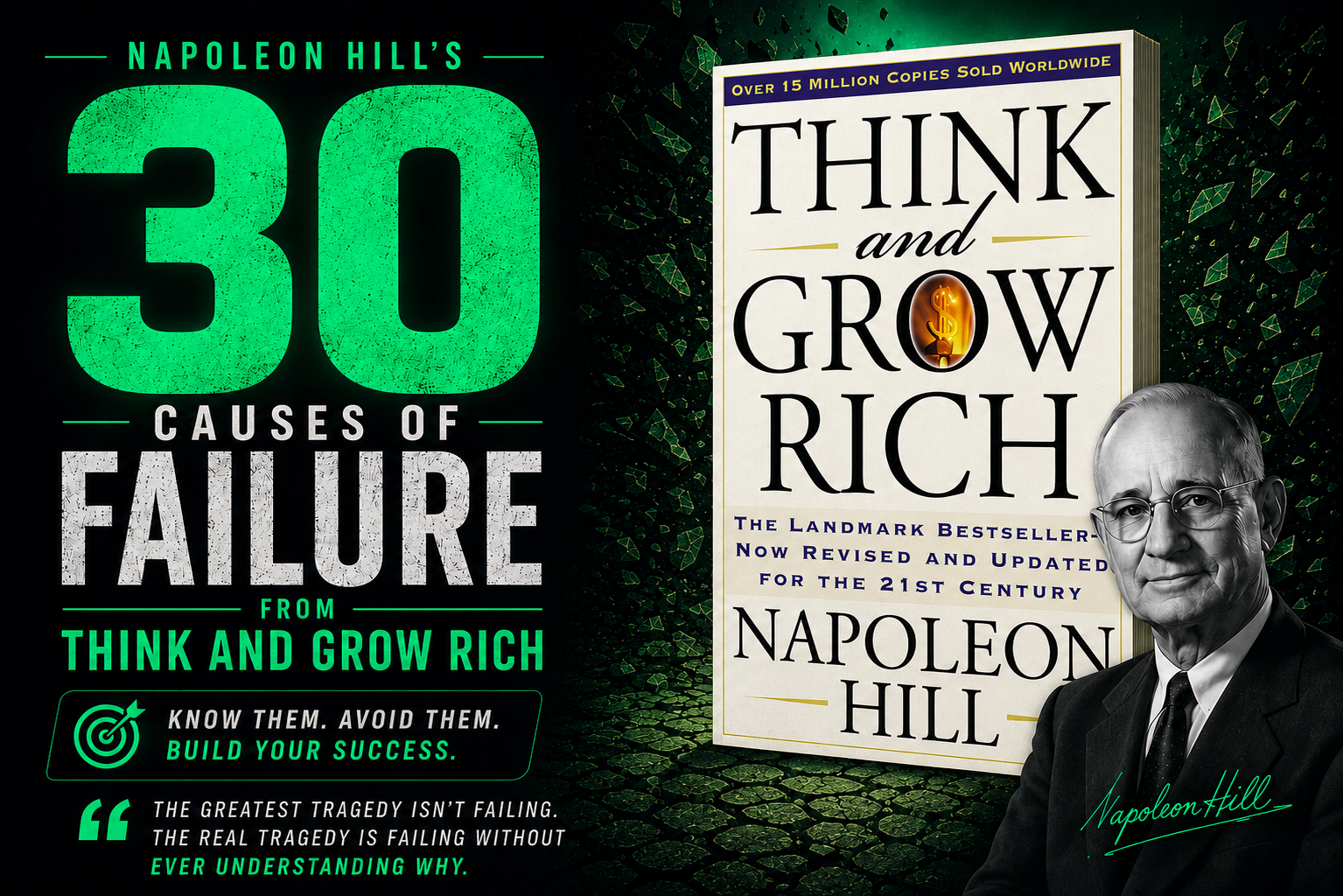
Why Do People Fail in Life? It’s a question most of us have asked at some point — especially when we’ve given everything we had and still came up short. Why do some people achieve extraordinary success while others, despite sincere effort, never seem to get ahead?
In today’s article, we’re going to break down the 30 major causes of failure based on Napoleon Hill’s masterpiece Think and Grow Rich — one of the most studied self-development books ever written.
Napoleon Hill spent years analyzing thousands of men and women, finding that 98% of them were classified as failures. His research revealed that failure, just like success, follows a pattern. There are specific, identifiable causes — and once you know them, you can start eliminating them from your life.
Understanding why do people fail in life is the first step toward making sure you never become part of that 98% statistic Napoleon Hill wrote about.
The greatest tragedy isn’t failing. The real tragedy is failing without ever understanding why.
Read through this list carefully and ask yourself honestly — how many of these are holding you back?
Table of Contents
The 30 Major Causes of Failure According to Napoleon Hill
1. Unfavorable Hereditary Background
People born with a deficiency in mental capacity cannot easily remedy this. Our philosophy offers only one method for overcoming this weakness—through the aid of the “Master Mind” (collective genius). Note, however, that this is the only one of the 30 causes which cannot be easily corrected by the individual. You may not be able to change where you started, but you can choose who you surround yourself with.
2. Lack of a Well-Defined Purpose in Life
There is no hope of success for the person who does not have a central goal, a definite purpose at which to aim. Ninety-eight out of every hundred people analyzed had no such aim. This might well be the primary cause of their failure.
3. Lack of Ambition to Aim Above Mediocrity
We offer no hope for the person who is so indifferent that they do not want to get ahead in life, and who is simply not willing to pay the price for success. But if you are reading this, you likely want something greater. The hard truth is that success has a price, and those who are unwilling to pay it will never rise above mediocrity.
4. Insufficient Education
This is a handicap which can be overcome with relative ease. Experience has shown that the best-educated people are often those who are self-made or self-educated. A university degree does not make a person educated. An educated person is one who has learned to get whatever they want in life without violating the rights of others. Education consists not so much of knowledge, but of effectively and practically APPLIED knowledge. People are paid not for what they know, but for WHAT THEY DO WITH WHAT THEY KNOW.
5. Lack of Self-Discipline
Discipline comes through self-control. This means that a person must control all their negative qualities. Before you can control conditions, you must first learn to control yourself. Self-mastery is the hardest job you will ever face. If you do not conquer self, you will be conquered by self. You can see both your best friend and your greatest enemy at the same time just by standing in front of a mirror.
6. Ill Health
No person can enjoy outstanding success without good health. Many of the causes of bad health are subject to mastery and control. These include:
- Overeating of foods harmful to health.
- Wrong habits of thought; a tendency toward negativity.
- Wrong use of and overindulgence in sex.
- Lack of proper physical exercise.
- An inadequate supply of fresh air due to improper breathing.
7. Unfavorable Environmental Influences During Childhood
“As the twig is bent, so the tree will grow.” Most people who have criminal tendencies acquired them as a result of a bad environment and improper associates during their childhood. Many of our deepest beliefs, habits, and behaviors were shaped during childhood, often without our awareness. A negative environment, toxic relationships, or harmful influences during those early years can leave lasting damage. The important thing to understand is that while you cannot change your past, you can become aware of how it shaped you — and make a conscious decision to grow beyond it.
8. Procrastination
This is one of the most common causes of failure. “Old Man Procrastination” stands in the shadow of every human being, waiting for his opportunity to spoil their chances of success. Most of us go through life as failures because we are waiting for the “time to be right” to start doing something worthwhile. Do not wait. The time will never be “just right.” Start right where you stand, and work with whatever tools you may have at your command, and better tools will be found as you go along.
Procrastination today is heavily fuelled by distraction — and nothing steals focus quite like endless scrolling. If this resonates with you, read our guide on how to beat social media addiction and take back control of your time.

9. Lack of Persistence
Most of us are good “starters” but poor “finishers” of everything we begin. Moreover, people are prone to give up at the first signs of defeat. There is no substitute for persistence. The person who makes persistence their watchword will find that “Old Man Failure” finally becomes tired and leaves. Failure cannot cope with persistence.
10. Negative Personality
There is no hope of success for the person who repels others through a negative personality. Success comes through the application of POWER, and power is attained through the cooperative efforts of other people. A negative personality will not induce cooperation. When we study why do people fail in life, patterns like a negative personality keep appearing at the top of the list — because success is never built alone.
11. Lack of Controlled Sexual Urge
Sexual energy is the most powerful of all the stimuli which move people into action. Because it is the most powerful emotion, it must be controlled through transmutation and redirected into other channels. Sexual energy, according to Napoleon Hill, is among the most powerful forces in human nature. When left uncontrolled, it can drain focus, cloud judgment, and lead to destructive decisions. But when that energy is disciplined and redirected — a process Hill called “transmutation” — it becomes one of the greatest drivers of creativity, ambition, and achievement.
12. Uncontrolled Desire for “Something for Nothing”
The gambling instinct drives millions of people to failure. Evidence of this can be found in the crash of Wall Street, where millions of people tried to make money by gambling on stock margins. The get-rich-quick mentality has destroyed more potential than almost any other mindset. The gambling instinct — the desire to gain without effort — drives millions toward failure every year. Whether it’s lottery tickets, risky speculation, or chasing shortcuts, this pattern leads to financial and personal ruin. Real success is built slowly, through consistent effort and value creation. There are no shortcuts worth taking.
13. Lack of a Well-Defined Power of Decision
Men who succeed reach decisions promptly and change them, if at all, very slowly. Men who fail reach decisions, if at all, very slowly, and change them frequently and quickly. Indecision and procrastination are twin brothers. Where one is found, the other is usually lurking as well. Destroy this pair before they bind you to the wheels of failure. Practice making clear, firm decisions. You won’t always be right — but a wrong decision acted upon is often more productive than no decision at all.
14. One or More of the Six Basic Fears
Napoleon Hill identified six basic fears that silently sabotage human potential — the fear of poverty, criticism, ill health, loss of love, old age, and death. Most people carry one or more of these fears without ever consciously recognizing them. These fears shape decisions, limit action, and keep people trapped in comfort zones that are anything but comfortable. Identifying and confronting your fears is not optional — it is essential to any real progress.They must be mastered before you can market your services effectively.
15. Wrong Selection of a Mate in Marriage
This is a very common cause of failure. The relationship of marriage brings people into intimate contact. Unless this relationship is harmonious, failure is almost bound to follow. Moreover, it will be a form of failure marked by misery and unhappiness, destroying all ambition. Choose wisely, nurture intentionally, and build a partnership that lifts both of you higher. Relationship choices are one of the most overlooked answers to the question of why do people fail in life. Your closest relationship will either fuel your ambition or slowly drain it.
16. Over-Caution
The person who takes no chances generally has to take the leftovers when others are through choosing. Over-caution is just as bad as under-caution. Both are extremes to be guarded against. Life itself is filled with the element of chance.
Life rewards those who are willing to act despite uncertainty. Over-caution and recklessness are both extremes — the goal is calculated, informed risk-taking. The person who never bets on themselves will always be left with whatever remains after bolder people have made their choices.
17. Wrong Selection of Associates in Business
This is one of the most common causes of failure in business. In marketing personal services, one should use great care to select an employer who will be an inspiration, and who is himself intelligent and successful. We emulate those with whom we associate most closely. Therefore, select an employer worth emulating.
18. Superstition and Prejudice
Superstition is a form of fear. It is also a sign of ignorance. Successful people keep open minds and are afraid of nothing. Both close the mind and block growth. Successful people operate with open minds — they seek facts, question assumptions, and refuse to let unfounded beliefs limit their decisions. If you want to grow, you must be willing to challenge what you think you already know.
19. Wrong Selection of a Vocation
No man can succeed in a line of endeavor which he does not like. You cannot build a great life doing work you hate. Passion and purpose are not luxuries — they are requirements for sustained excellence. When you are working in a field that genuinely excites you, persistence comes naturally, effort feels different, and results follow. If your current work feels like a prison sentence, it may be time to seriously reconsider your path. The most essential career move you can make is choosing work you can throw yourself into wholeheartedly.
20. Lack of Concentration of Effort
The “jack-of-all-trades” seldom amounts to much in anything. Concentrate all your efforts on one definite chief aim. Trying to do everything at once is a guaranteed way to master nothing. The person who chases multiple directions simultaneously rarely goes far in any of them. Focus is a force multiplier. Identify your one definite chief aim and direct the majority of your energy toward it. One of the clearest answers to why do people fail in life is simply this — they spread themselves too thin and never go deep enough in any one direction.
21. The Habit of Indiscriminate Spending
The spendthrift cannot succeed, mainly because he stands in eternal fear of poverty. Form the habit of systematic saving by putting aside a definite percentage of your income. Money in the bank gives a person a solid foundation of courage when bargaining for the sale of personal services. Without money, one must take what is offered and be glad to get it. Financial carelessness is not just a money problem — it’s a mindset problem. The person who spends without discipline lives in constant anxiety about money, which weakens their confidence and their negotiating power. Building the habit of saving — even a small percentage of your income consistently — creates a foundation of security and freedom. Money in reserve gives you options. Options give you power.
22. Lack of Enthusiasm
Without enthusiasm, one cannot be convincing. Furthermore, enthusiasm is contagious, and the person who has it under control is generally welcome in any group of people. You don’t need to be loud to be enthusiastic — but you do need to genuinely care about what you’re doing.
23. Intolerance
The person with a “closed” mind on any subject seldom gets ahead. Intolerance means that a person has stopped acquiring knowledge. The most damaging forms of intolerance are those connected with religious, racial, and political differences of opinion.
Intolerance — whether toward different ideas, backgrounds, religions, or perspectives — is a signal that a person has stopped growing. The most dangerous forms of intolerance are those connected to race, religion, and politics, because they are often deeply emotional and rarely examined. Growth requires exposure to different viewpoints. The willingness to truly listen and consider is one of the most underrated success skills there is.
24. Intemperance
The most damaging forms of intemperance are connected with eating, strong drink, and sexual activities. Overindulgence in any of these can be fatal to success. Intemperance weakens willpower, clouds judgment, and slowly dismantles the habits that high performance requires. Moderation is not about restriction — it’s about protecting your ability to perform at the level your goals demand.
25. Inability to Cooperate with Others
More people lose their positions and their big opportunities in life because of this fault than for all other reasons combined. It is a fault which no well-informed businessman or leader will tolerate.
26. Possession of Power That Was Not Acquired Through Sincere Effort
(Such as the sons and daughters of wealthy men, or those who inherit money they did not earn). Power in the hands of one who did not acquire it gradually is often fatal to success. Quick riches are more dangerous than poverty.
When someone receives significant power or resources without having gone through the process of earning them, they usually lack the judgment, resilience, and perspective to use them wisely. Quick riches are often more destructive than poverty — because poverty at least teaches hunger. Earned success builds character. Unearned success can quietly destroy it.
27. Intentional Dishonesty
There is no substitute for honesty. One may be temporarily dishonest due to force of circumstances over which one has no control, without permanent damage. But there is NO HOPE for the person who is dishonest by choice. Sooner or later, their deeds will catch up with them, and they will pay with the loss of reputation, and perhaps even their liberty. Reputations, once lost, are nearly impossible to rebuild. Trust, once broken, rarely fully returns. There is simply no sustainable path to success built on a foundation of lies.
28. Egotism and Vanity
These qualities serve as red light signals which warn others to keep their distance. They are fatal to success.
The most accomplished people tend to be remarkably humble, because they understand how much they still don’t know. Let your results speak. Stay teachable. Keep your ego in its place.
The Dunning-Kruger Effect
In 1999, psychologists David Dunning and Justin Kruger from Cornell University conducted a groundbreaking study that revealed a painful truth about human nature — people with limited knowledge in a subject tend to dramatically overestimate their own competence. Meanwhile, people who are genuinely skilled tend to underestimate themselves, because they are aware of how much more there is to learn. If you want to dive deeper into the research behind this effect, you can read the full breakdown at EBSCO Research.
29. Guessing Instead of Thinking
Most people are too indifferent or lazy to acquire FACTS with which to think accurately. They prefer to act on “opinions” created by guesswork or snap judgments.
Most people are too busy — or too lazy — to gather the facts before making decisions. Instead, they act on assumptions, gut feelings, and secondhand opinions. This habit of guessing instead of thinking leads to poor decisions, repeated mistakes, and wasted effort. Accurate thinking requires effort. It means seeking facts, questioning assumptions, and resisting the urge to conclude before you’ve actually investigated. Slow down, think clearly, and decide on evidence — not emotion.
30. Lack of Capital
This is a common cause of failure among those who start out in business for the first time without a sufficient reserve of capital to absorb the shock of their mistakes and to carry them through until they have established a reputation. If you’re planning to start something new, build your financial foundation first. A business launched on solid footing has a far greater chance of surviving long enough to succeed.
Final Thoughts: Why Do People Fail in Life and How To Stop It
If you have ever asked yourself why do people fail in life while others seem to succeed effortlessly — now you have the full picture. Napoleon Hill didn’t spend years studying thousands of people so we could read this list and move on. He did it so we could look in the mirror, identify our patterns, and make a decision to change them.
The truth is uncomfortable but liberating — failure is rarely about talent, intelligence, or luck. It is almost always about habits, mindsets, and decisions that can be identified, confronted, and replaced. Every single cause on this list, except one, is within your power to change. That is not a small thing. That is everything.
So here is the only question that matters right now — which of these 30 causes do you recognize in yourself? Not in your colleague, not in your family member, not in someone you know. In you. Be honest. That honesty is where your growth begins.
The best version of yourself is not waiting for the right moment. It is waiting for your decision.
Make it today.

Pingback: 12 Lessons from The Richest Man in Babylon That Still Build Wealth Today - Enes Aliev